Product Page Redesign
Overview
Led Bellroy's entry into wheeled luggage, hitting 40% of monthly sales target within a week of launch.
Role
Lead Product Designer
Year
2025
Company
Bellroy
Team
Developers, Marketing, Photography, Copywriting, Content Coordinators
Monthly sales target hit within 7 days
Average order value
FY25 budget attainment
Lift in average daily sales vs pre-launch
The problem
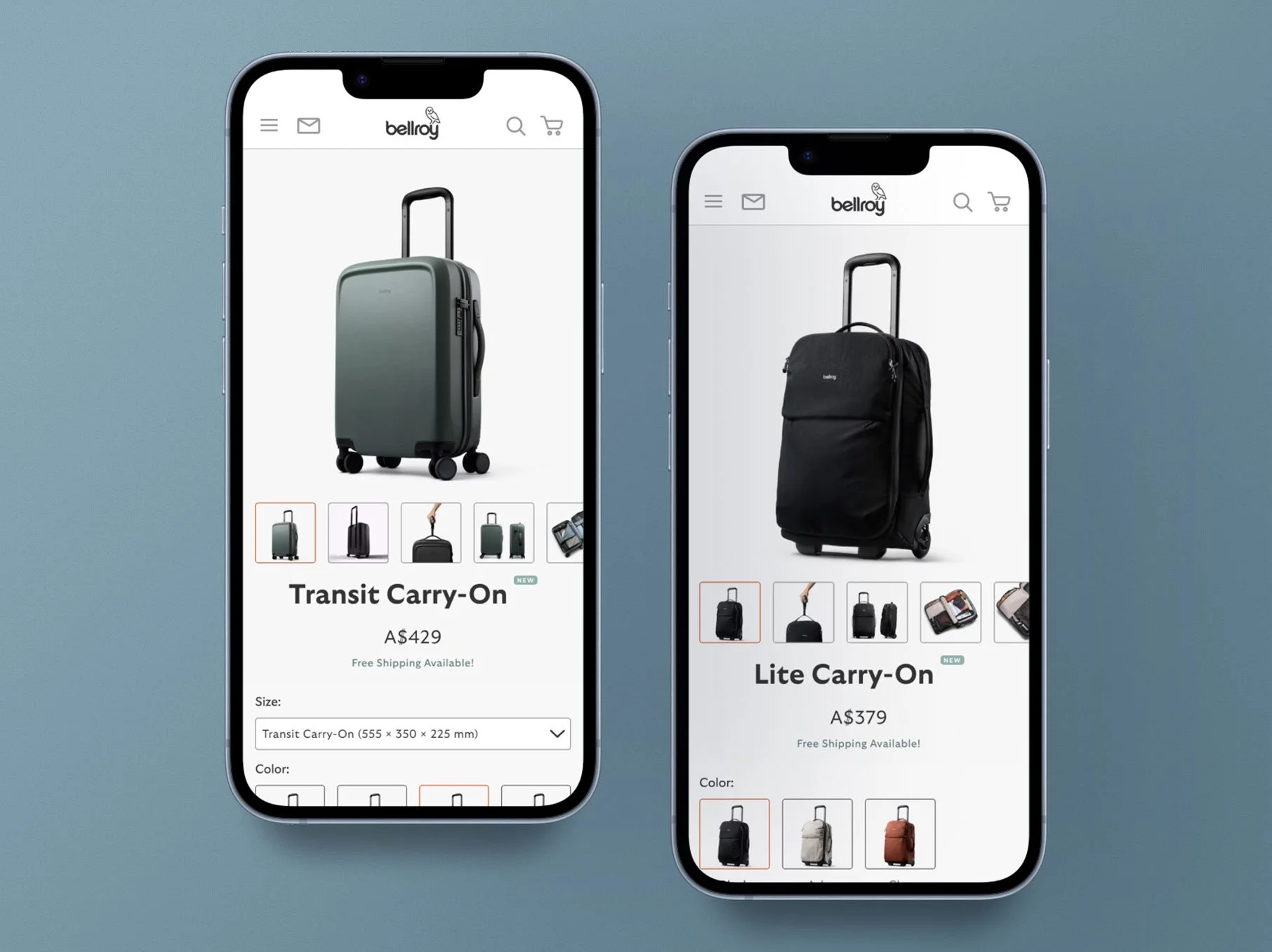
In early 2025, Bellroy launched into an entirely new category: wheeled luggage. Our existing product page templates, built and optimised for simpler items, weren't fit for purpose for a complex, high-consideration product like this. The task was to lead a full redesign that could support richer storytelling, clearer technical specification, and product visualisation strong enough to help customers feel informed, confident, and inspired to buy.
My role & key decisions
As Lead Product Designer, I owned the end-to-end experience: research, stakeholder alignment, wireframing, prototyping, defining imagery, video and copy needs, testing, handoff, QA, and final implementation. A major customer pain point was the difficulty comparing similar products, so I introduced a redesigned comparison module that clearly outlined shared and differing attributes using visual icons and simplified copy. I also made the call to include airline compatibility information directly on the page, removing a key source of sizing uncertainty, and to restructure the information hierarchy entirely so customers received the right detail in the right order to purchase with confidence. Video became a deliberate focus rather than an afterthought, both as a storytelling tool and a business driver, which meant pushing for frameless, autoplay video support directly on bellroy.com.

How I approached it
I grounded the redesign in a comprehensive audit of our existing product pages, identifying friction points, visual inconsistencies, and accessibility gaps, then built journey maps and customer personas specific to the luggage category to understand the mindset behind a higher-consideration purchase. A competitor analysis clarified how market leaders approached their own product experiences and helped define where Bellroy should position itself, while stakeholder interviews across marketing, creative, and wholesale surfaced how different teams relied on product pages to meet both customer and business needs. I also facilitated a feature prioritisation session, presenting key research findings and having stakeholders collaboratively vote on priorities to align the team before design work began. This was a deeply cross-functional effort, and keeping it on track meant frequent check-ins with project coordinators and constantly negotiating timelines and priorities across a large team, developers, marketers, photographers, copywriters, and translation teams among them.

Early workshop aligning stakeholders on product and category goals

Auditing the existing product page experience, what worked and what didn't
Competitor teardown across product, design, and spec pages
Mapping the customer journey from awareness to decision
Results & Impact
The new template outperformed the old one on both technical and business measures. On performance: Speed Index on mobile improved by 29% despite significantly more content on the page, First Contentful Paint improved 16% on desktop, and accessibility was built in from the ground up, standardised contrast, focus states, and keyboard navigation across every new component. On the business side, we hit 40% of monthly sales target within 7 days of launch, and web sales as of June 2025 show 168% attainment against FY25 budget. The luggage launch has permanently lifted Bellroy.com's baseline performance too, with average daily sales up 16% compared to pre-launch levels, and luggage conversion is performing competitively against our other product categories. Given how recent the launch is, performance analysis is still evolving as more data comes in.
What's next
This redesign has set the new standard for product pages across Bellroy.com. I'm now coordinating a phased rollout applying the model to other categories, starting with testing on individual components and content modules to understand what actually drives conversion for different product types, from high-investment items like luggage to quick-buy accessories like phone covers. That work is laying the foundation for a scalable, data-informed framework for product presentation, one that matches content investment to product complexity rather than treating every product page the same, and supports smarter decisions across design, marketing, and merchandising.